Nice
Promise at DawnNice is the narrator’s mother’s home and the setting of the Hôtel-Pension Mermonts, the family’s place of work, reunion, illness, and eventual loss. For Romain Gary, the city gathers together two powerful inheritances: his mother’s idealized vision of France and the actual, difficult life they shared there. He repeatedly imagines returning to Nice with honor, but his final homecoming reveals that his mother has died and has secretly arranged to sustain him from afar.
The city and the mother’s French ideal
Nice belongs to the narrator’s life not merely as a destination but as the home shaped by his mother’s ambitions. His childhood ideas of France were formed elsewhere, in the depths of a Lithuanian forest, through the legends his mother told and the beauty of France reflected in her face. Yet that ideal became inseparable from the family’s life in Nice. The narrator says that his mother would sit opposite him whenever their frequent difficult times arrived and assure him that he would become an Ambassador of France. The city is therefore linked to a future she imagined for him: a life of distinction that would vindicate her confidence and her love of France.
That ideal collided with the country’s history and institutions. The narrator recalls that he did not learn of France’s defeat in 1870 until he attended the lycée in Nice; his mother had omitted it from the history she had given him. Her protective version of France, he explains, had formed a kind of inner Maginot Line of certainty. Nice is where this cherished account meets historical knowledge, and where the contrast between his mother’s France and the imperfect country he comes to recognize begins to take sharper form.
Hôtel-Pension Mermonts and the hoped-for return
The Hôtel-Pension Mermonts, on the rue Dante, makes Nice a practical home as well as an emotional one. The narrator hopes that his military posting will allow him to visit frequently and appear with his mother at the Buffa Market or on the Promenade des Anglais. His wish is specific: he wants not only to be near her, but to show himself beside her in the familiar public places of their city. For him, military advancement and the imagined return to Nice are bound together with the desire to make his mother proud.
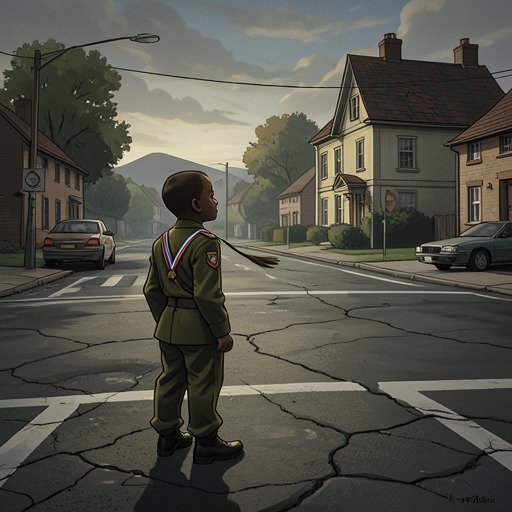
When he eventually comes home after the disappointment at Avord, the city stages the consequences of that failure. A tricolor flies above the freshly painted façade of the Mermonts, raised by his mother to celebrate what she believes is her son’s promotion to second lieutenant in the French Air Force. He arrives instead in a private’s uniform, with a red lance corporal’s stripe. Faced with her stunned incomprehension, he invents a plausible explanation involving a temporary disciplinary matter. The lie is an effort to shield her from disappointment and preserve, for her, the image of France as a place of beauty and justice. The flag above the hotel thus marks both her steadfast faith and the burden he feels in protecting it.
Illness, silence, and the city at war
A later return brings the narrator to the Mermonts in the early morning, expecting to find his mother in her room on the seventh floor. Its neat, empty appearance terrifies him. After waking the concierge, he learns that she has been taken to the Saint-Antoine Clinic and hurries there by taxi. In her room, he sits beside her without speaking. He draws the curtains when she asks, then raises his eyes to the light without waiting for her to ask again. He remains in the chair beside her bed for forty-eight hours, still wearing his leather jacket and cap, holding a dead cigar stub between his teeth as though he needs something to cling to. The silence and small gestures make this hospital visit one of the most intimate scenes associated with Nice.
The city is also the setting for his mother’s defiant response to France’s defeat. While the narrator is in Meknès after the armistice has been accepted by the North African authorities, she gives her own call to resistance from Mr. Pantaleoni’s vegetable stand at the Buffa Market. Standing on a chair among carrots, beetroots, and lettuces, she brandishes her cane and urges people to reject the armistice and continue the war from England and North Africa. She even shows those present a page containing one of her son’s short stories, presenting him as the famous writer and diplomat already striking at the enemy. The public scene in Nice echoes her long-standing conviction that her son and France are destined for distinction, even as the narrator feels he has failed to become the person she wanted him to be.
Letters, absence, and the final homecoming
During the separation, Nice remains present through the letters that reach the narrator. In a letter written after he has gone for months without news of her, his mother urges him not to worry, tells him he is a man who can stand on his own feet, and encourages him to marry and write a great book. The narrator reads and rereads it above the Nile, troubled by its new sadness and by the fact that, for the first time, she does not speak of France. Later letters arriving from Nice carry tenderness and an unexplained apology. He cannot understand what she believes requires his forgiveness, but takes comfort in the thought that she is alive and that he may yet return to her.
After the Allied landings, those letters seem to him to carry a sense of joy and serenity, as though his mother knows that his homecoming is near. He expects to bring her both the fame of his book and the Cross of the Liberation, pinned to his tunic by Charles de Gaulle. But on reaching the Mermonts, he finds no one waiting. The people there remember only vaguely a strange Russian woman who once ran the hotel. His mother died three years and six months earlier, a few weeks after his departure for England.
The final revelation changes the meaning of the letters and of Nice itself. In the last days of her life, his mother wrote nearly two hundred and fifty letters and sent them to a friend in Switzerland, with instructions that the undated messages be forwarded at intervals. Their continuing arrival had concealed her death and preserved the support he believed still came from home. The Mermonts, once the place to which he hurried in hope of reunion, becomes the point at which he discovers how long that reunion has been impossible. Nice closes the distance between his wartime expectation and the truth: his mother had continued to give him strength from the city even after she was gone.